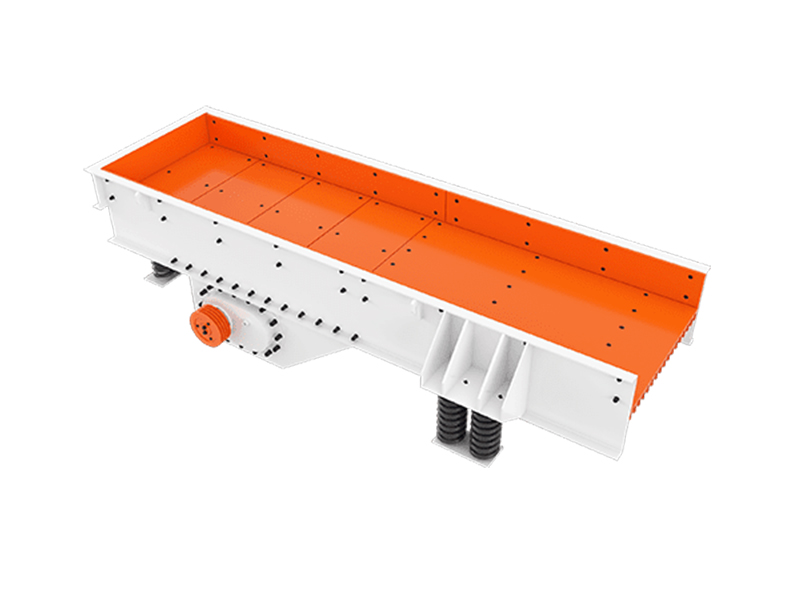
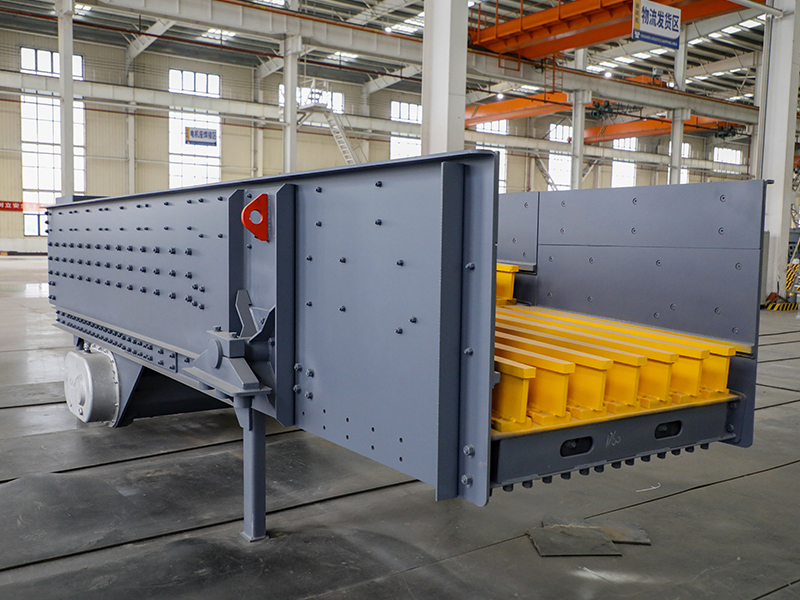
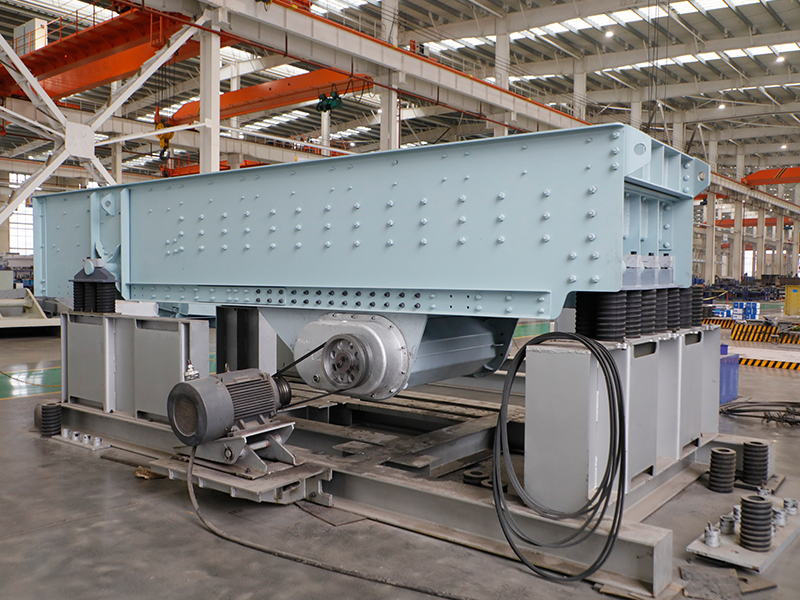
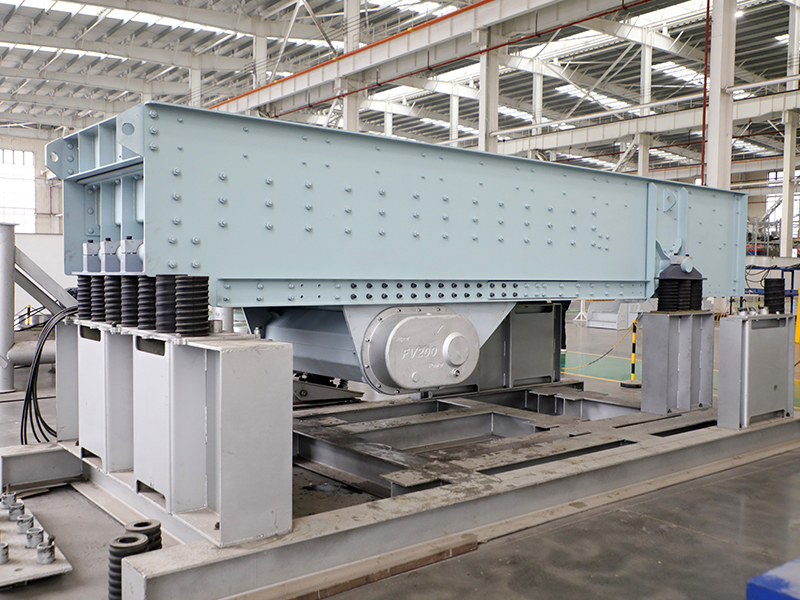
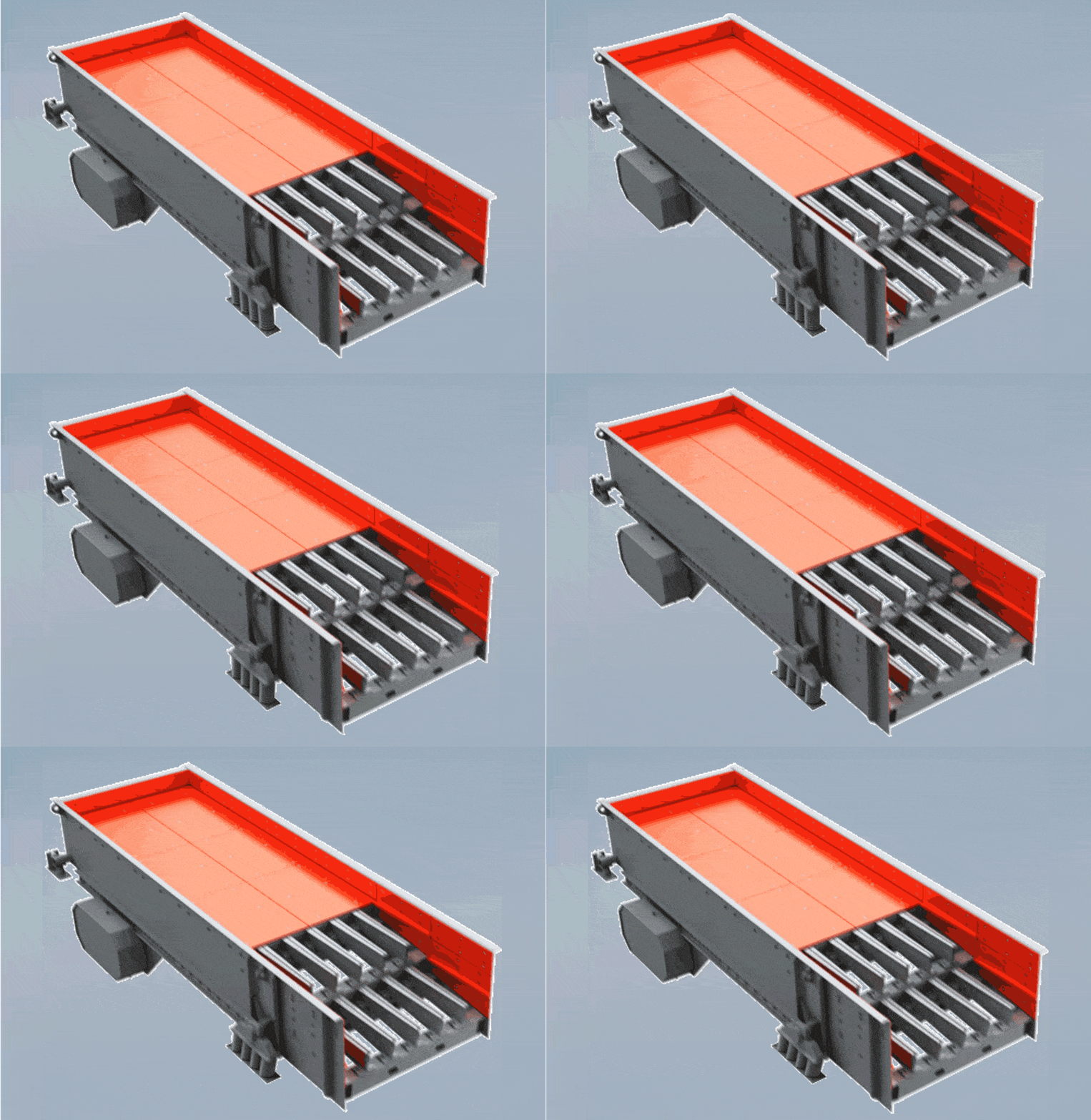
A vibrating feeder is a device that uses a vibrating motor or electromagnetic exciter to generate directional vibration force, driving the trough to perform periodic reciprocating vibration, thereby achieving uniform, continuous, and quantitative material conveying. This equipment has a simple structure, reliable operation, and convenient adjustment, making it an indispensable pre-processing feeding device in crushing and screening production lines.
Core Components of the Equipment
Trough: Carries the material, made of wear-resistant steel plate, and can be lined with wear plates according to material characteristics.
Vibrating Motor: Provides the excitation source; two motors rotate synchronously in opposite directions to generate directional vibration force.
Damping Springs: Support the trough, absorb vibration, and reduce the dynamic load transmitted to the foundation.
Support/Suspension Device: Fixes the equipment; can be installed in a seated or suspended manner.
Control Cabinet (optional): Integrates a frequency converter to achieve stepless adjustment of feeding volume and remote control.
Advantages and Features
Stable operation and uniform feeding: Uses dual vibrating motors for synchronous drive, ensuring stable amplitude and continuous, uniform material conveying, preventing blockages or interruptions.
Energy-efficient and low noise: Driven by vibrating motors, energy consumption is reduced by more than 30% compared to traditional feeding equipment, resulting in low operating noise and a friendly working environment.
Simple maintenance and long service life: The trough is made of wear-resistant steel plate, the structure is robust, key components are sealed and dustproof, daily maintenance is simple, and the service life is long.
Convenient adjustment and strong adaptability: By adjusting the motor excitation force or using frequency control, the feeding volume can be easily adjusted to adapt to different materials and process requirements.
Working Principle
Two vibrating motors generate directional excitation forces, driving the feeding trough to perform periodic linear reciprocating vibrations along an inclined direction.
Material Movement Conditions:
When the vertical component of the trough's vibration acceleration is greater than the acceleration due to gravity, the material in the trough is continuously thrown up.
Material Conveying Method:
The material moves forward in a jumping motion, achieving uniform and continuous conveying.
Feeding Speed Adjustment:
Controlled by adjusting the excitation force of the motors.
Alternatively, stepless speed regulation can be achieved by installing a frequency converter.
Technical Parameters
Model
Trough size(mm)
Max feed size(mm)
Capacity (t/h)
Motor Power (kw)
Overall dimension L*W*H(mm)
ZSW650×2500
650×2500
560
50-90
1.1×2
2570×890×1000
ZSW850×3000
850×3000
780
80-120
7.5
3110×1800×1100
ZSW960×3800
960×3800
820
120-210
11
3850×1950×1100
ZSW1100×4200
1100×4200
1000
200-430
15
4400×2050×1200
ZSW1100×4900
1100×4900
1000
280-500
18.5
5200×2050×1200
ZSW1300×4900
1300×4900
1100
450-600
22
5200×2350×1400
ZSW1300×6000
1300×6000
1100
450-680
22
6300×2300×1400
ZSW1500×6000
1500×6000
1280
550-1200
30
6300×2550×1400
Any change of technical data will not be advised separately.